


Quebec Online Casino Payouts in 2026: How to Spot a Site That Actually Pays
Quebec Online Casino Payouts in 2026: How to Spot a Site That Actually Pays
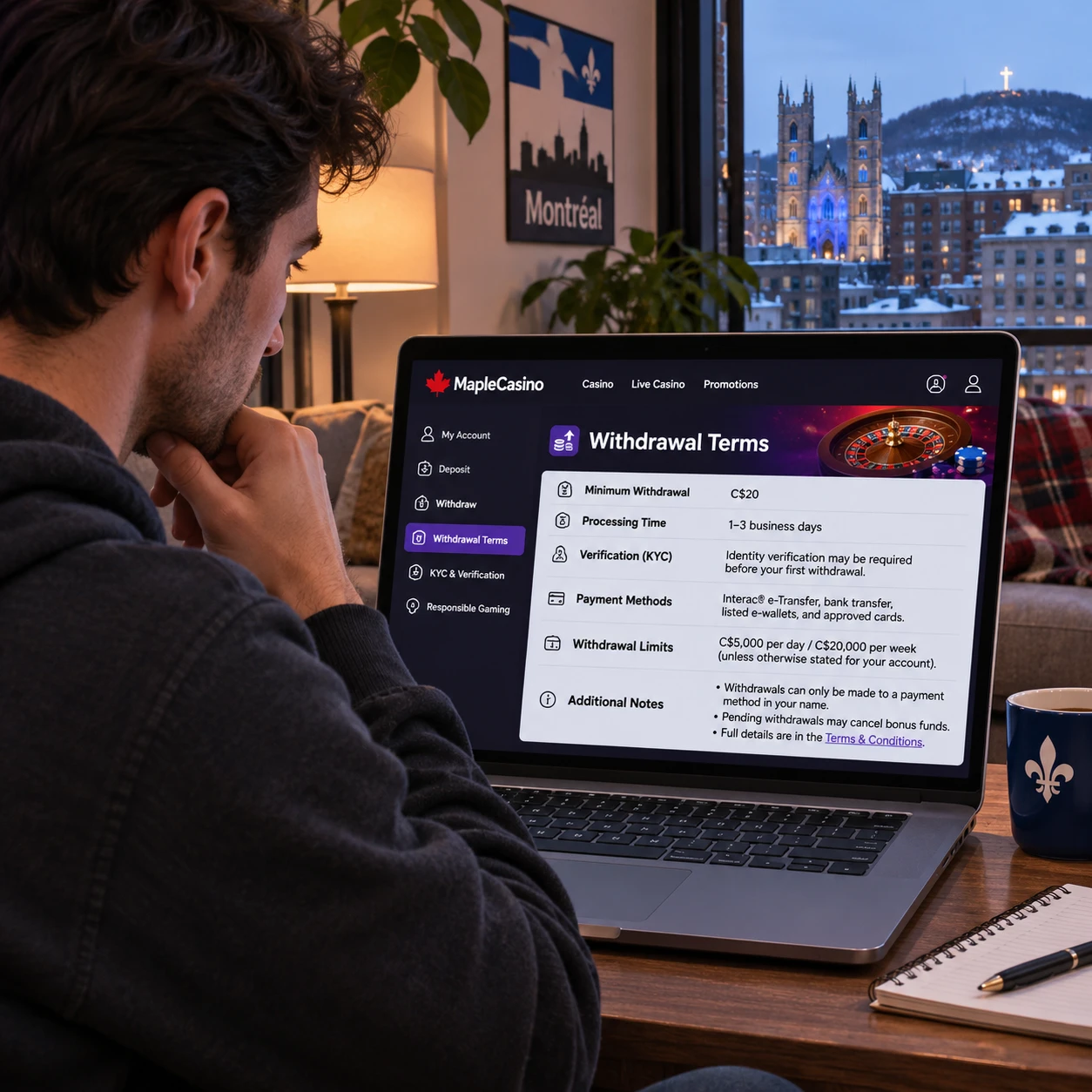
You know the feeling. The welcome bonus looked generous, the spins ran better than expected, and for about ten minutes you were already spending money that hadn't arrived yet. Then you hit withdraw and the screen goes quiet. A 'pending' status that doesn't move. A support agent who answers everything except the one question you actually asked. A terms page where some clause you never noticed turns a $2,000 win into a $250 maximum cashout.
I've had that conversation with Quebec players more times than I can count. The maddening part? None of it is illegal. It's just badly chosen. The site paid — technically. It paid far less, far later, than the player had any reason to expect.
So here's my practical 2026 framework for judging whether a casino genuinely pays. What the phrase should mean. How to check it before you deposit a dollar. How long withdrawals really take, method by method. And where the provincial rules leave you protected versus completely on your own. In Quebec, payant should be a measurable quality — payment history, licensing, cashout transparency — not a badge some marketing team designed.
What 'Genuinely Paying' Actually Means in 2026
Worth defining precisely, because the rest of this falls apart if I don't. A genuinely paying casino is one where a verified player gets the full expected amount, in a reasonable time, with no surprise deductions. Not a site that once processed a withdrawal for somebody. Not a site with a Trustpilot score inflated by deposit-only reviews. Full amount. Reasonable time. No surprises.
Players constantly blend three separate things together, and operators are happy to let them:
- Payout rate (RTP) — the long-run return baked into the games themselves.
- Payout reliability — whether the operator honours cashouts when you ask.
- Payout speed — how many hours or days until the money lands in your account.
RTP, House Edge and the Numbers That Matter
Here's what took me years to internalise: RTP is set by the game provider, audited by third parties, and essentially identical wherever that slot is hosted. A 96% RTP game returns 96% on the same maths whether it sits on a slick new site or a tired old one. The operator can't quietly shave it — that's the provider's number.
Reliability is the opposite. That's entirely the operator's behaviour, and it's the only one of the three a casino can actually cheat on. So when you're vetting a site, RTP tells you almost nothing about whether you'll get paid.
There's a subtler trap too: advertised RTP versus effective RTP once bonus wagering is factored in. If a bonus carries 40x wagering on a game that contributes only 10% toward the requirement, your realistic return on that bonus money looks nothing like the headline figure. That bonus isn't free money with a small catch. It's a separate, much worse game bolted onto your deposit.
Why Licensing Changes Everything About Payout Risk
A licence isn't a logo in the footer. It's a complaints route. If an operator withholds your payment, the question that matters is simple: who do I escalate to, and will that body actually act?
In Quebec, the provincial model runs through Loto-Québec, which operates the provincially managed online offering. Most offshore-facing sites serving Quebec players hold licences issued elsewhere — the Kahnawake Gaming Commission is the most common for this market. Those frameworks do have dispute mechanisms, but they're not the same as a provincial regulator with a mandate to intervene on your behalf. Some offshore licences are genuinely responsive. Others exist mostly to let an operator stick a seal on a page.
Before you deposit: find the licence number, find the regulator's own site, confirm the operator is listed there. Then find the dispute resolution page. If you can't locate either in five minutes, that tells you something about how a payment complaint is going to go.
How to Spot a Genuinely Paying Site — A Seven-Point Check
This is the checklist I run every time, in order. Fifteen minutes, roughly, and it has saved me more than any bonus ever did.
- Verifiable licence and registration details. Licence number, issuing authority, registered company name and address — all present, all checkable against the regulator's public register.
- Published cashout limits and fees. Minimum and maximum withdrawal amounts, per-transaction and per-period, plus every fee, on a page you can find without needing a search engine.
- Clear, dated terms and conditions. A visible 'last updated' date and a change log. Undated terms can be rewritten around your win.
- Independent audit certificates. Current eCOGRA, iTech Labs or equivalent testing certification for the game portfolio.
- Payment history in player reviews. Read the reviews that describe withdrawal outcomes — amounts, methods, delays. Skip the ones that only talk about sign-up bonuses, because those tell you nothing.
- Responsive live support that answers in writing. Ask a specific payout question before depositing, and keep the chat transcript. An answer you can screenshot beats ten verbal assurances.
- KYC requirements stated before deposit. Identity and address documents should be listed up front, not revealed after a win when you're in no position to argue.
Reading the Terms Before You Deposit
The withdrawal section is the only part of the terms that matters, and it's usually the part nobody opens. Five clauses decide whether your win is actually payable:
- Maximum cashout caps on bonuses. The single most expensive clause in the industry. A cap of a few hundred dollars turns a headline jackpot into a marketing prop.
- Wagering contribution by game type. Slots usually contribute 100%, table games often 10% or less, and some games contribute nothing at all.
- Withdrawal-hold periods. The window where your request sits as 'pending' and can still be reversed.
- Dormancy and inactivity fees. Some accounts get charged for sitting idle, which can quietly eat a balance you forgot about.
- 'All decisions final' language. Reasonable for bonus abuse. Not reasonable when it covers every payment dispute. I'd avoid those.
Cross-Checking a Shortlist Against an Independent Directory
Once you've narrowed it to three or four candidates, opening a dozen browser tabs to compare them is miserable and error-prone. I'd rather start from a comparison resource that lists licensing, banking methods and cashout conditions side by side. A regularly updated directory of casino en ligne payant québec is useful precisely because it puts payout terms, deposit and withdrawal options, and provincial compliance notes in one place — you spot the outliers in a few minutes instead of losing an afternoon to it.
But use it critically. A directory is a starting point for verification, not a replacement for it. Take the three sites it recommends, then go read each operator's own withdrawal terms yourself. If a directory's summary and the operator's terms disagree, the operator's terms win. Every time.
Comparing Withdrawal Speeds and Banking Options
'Instant withdrawal' almost always refers to the first stage only. A cashout actually moves through five:
- Request submitted — you, immediately.
- Internal pending period — the operator, usually 24 to 72 hours.
- KYC and security review — the operator, hours to several days.
- Processor release — the payment provider, minutes to a couple of days.
- Bank settlement — your bank, same day to three business days.
Notice how much of that you don't control. You control stage one. And you control whether your documents are already verified before stage three starts. That's it — and it's enough to turn a multi-day cashout into a same-day one.
Interac, Cards, Bank Transfer and Crypto Side by Side
- Interac e-Transfer and Interac Online: usually the fastest fiat route for Quebec players. Widely supported, low or no fees, and settlement typically within hours once released. My default choice.
- Credit and debit cards: broad acceptance, but slower settlement and the occasional processing restriction on gambling transactions. Refunds to cards can take several business days.
- Bank transfer: reliable for large amounts and generally the best option above a few thousand dollars. Also the slowest, often three to five business days.
- E-wallets and crypto: quick at the operator end, variable on the cash-out side — converting back to dollars adds a step, and the rules around crypto gambling are worth checking against both provincial and federal positions before you rely on it.
The trade-off is always speed versus limits versus traceability. Interac is fast and traceable but capped per transaction. Bank transfer handles size, not speed. Crypto is fast and less traceable, which is exactly why it's the one I'd research most carefully.
Why Some Withdrawals Take Days — Pending Periods and KYC
Most delays are policy, not technology. The pending window exists to let you reverse the withdrawal — framed as flexibility, functioning as a second chance to lose it back. Requesting a cashout before identity verification is complete guarantees a hold. Unfinished bonus wagering locks the balance entirely. And larger amounts routinely trigger enhanced review, which is legitimate, just slow.
One habit solves all of it: verify your identity the day you open the account, then make a small test withdrawal — $50 or so — long before a large win depends on it. You'll learn the real timeline for your method and your account, and you'll find out whether the operator pays while the stakes are still low.
Staying Compliant With Quebec's Rules
Gambling in Canada is governed federally by the Criminal Code, which empowers the provinces to conduct and manage gaming within their borders. In Quebec that authority sits with Loto-Québec, which runs the provincially managed online offering. Sites operating outside that framework and serving Quebec players generally hold licences issued elsewhere — most commonly the Kahnawake Gaming Commission. That's a two-tier market, and it's better to understand it than to pretend it doesn't exist.
What Compliance Means for the Player, Not Just the Operator
Compliance isn't just the operator's problem. The legal gambling age in Quebec is 18. Winnings aren't treated as taxable income in Canada the way lottery-style or professional income can be, but reporting obligations depend on your circumstances — and I'd talk to an accountant about anything substantial rather than trust a forum post. Responsible-gambling tools (deposit limits, session limits, self-exclusion) are available and worth setting before you play, not after.
And here's the one that actually costs people money: playing on a site not licensed by the province removes your access to provincial dispute mechanisms. If that site withholds a payment, your only route is the offshore regulator and whatever goodwill the operator happens to have. Compliance protects your ability to be paid. That's the practical argument, separate from any legal one.
Advertising Claims, Bonuses and the Fine Print
Promotional language is regulated in some channels and loosely policed in others — affiliate sites and social media especially. 'Guaranteed payout' is not a regulated term in any jurisdiction I've seen. Treat it as marketing, because that's all it is.
The practical test for any bonus: is this structure compatible with a fast cashout, or designed to delay one? Look at the cap, the wagering multiplier, the contribution table, and the maximum bet allowed while wagering. If those four numbers make a cashout mathematically unlikely, the bonus is a retention tool wearing a gift's clothing.
Common Mistakes That Cost Players Their Winnings
- Chasing a bonus with a low cashout cap. Check the cap before you opt in — if it sits below what you'd reasonably win, decline the bonus.
- Depositing before reading the withdrawal section. Read it first. Always. It's ten minutes.
- Using a payment method in someone else's name. The method has to match the account holder exactly, or the cashout gets frozen.
- Requesting large cashouts before verification. Verify on day one, not on win day.
- Ignoring conversion and processor fees. Calculate the net amount, not the gross.
- Opening multiple accounts for repeat bonuses. Fastest route to a confiscated balance and a closed account.
- Assuming RTP guarantees a profitable session. RTP is a long-run average over millions of spins. It says nothing about your evening.
Frequently Asked Questions
How long should a legitimate withdrawal take in Quebec? With verified documents and Interac, same day to 48 hours is normal. Bank transfers typically take three to five business days. Anything past a week without a documented reason deserves a written escalation.
Are Interac cashouts really instant? No. Interac itself settles quickly, but the operator's pending period and KYC review sit in front of it. Expect hours to two days end to end.
Do I pay tax on online casino winnings in Canada? Gambling winnings aren't generally treated as taxable income, but the rules are nuanced and depend on your situation. Get professional advice for anything significant.
Is it legal to play on an offshore site from Quebec? The player isn't the target of the Criminal Code provisions — operators are. But you lose provincial dispute mechanisms, and that's a real practical cost.
What's the minimum I should test-withdraw? Around $50. Enough to be a real transaction, small enough that a delay or a fee doesn't hurt.
What if a casino refuses to pay? Collect everything — chat transcripts, screenshots, terms as they stood when you played — then escalate to the licensing authority named in the footer. If there isn't one, that's your answer about the site.
The Short Version
Three moves cover almost all of it. Verify the licence and find the dispute route. Read the cashout clauses before you deposit. Test a small withdrawal early. Do those and the bonus size stops mattering, because you'll know whether the site actually pays before you have anything riding on the answer.
A genuinely paying site is identified by documented payment behaviour — not by the size of its welcome offer or the polish of its landing page. And set your limits before you play, not after a loss, because the version of you who just lost three hundred dollars is not the version you want making that decision.
Through 2026 I expect payout transparency to become the main thing separating operators in this market. Players are getting better at asking how long a withdrawal takes and worse at being impressed by a headline number. Sites that publish clear timelines and hit them will win. Sites that hide behind 'instant' and pending windows will keep burning people until the reviews catch up. Choose accordingly.
